California Golden Bears Athletics
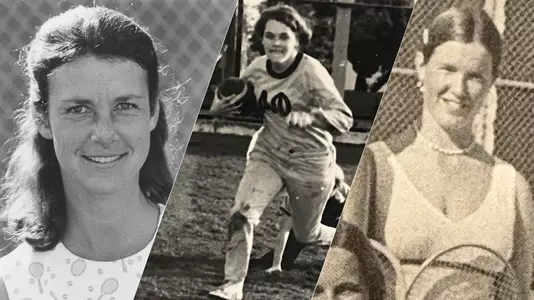
Joan Parker, left, Lynda Brothers, center, and Susan Woodward each fought hard for resources before the enactment of Title iX.
Photo by: Cal Athletics
Progress Before Progress
10/14/2026 11:16 AM | Inside The Lair, Athletics News
Before The Enactment Of Title IX, Female Student-Athletes Persisted Through Their Love Of The Game
Introduction
Hand-sewn uniforms, non-regulation facilities, and long drives in rented cars defined the experience of women's athletics at UC Berkeley in the early 1970s. For these student athletes, competition required as much improvisation as skill, as they navigated limited resources and constant hurdles. Yet what sustained them was not recognition or reward, but a deep love of the sport. Though Title IX would eventually reshape college sports, its early years on campus tell a different story — one where progress wasn't handed down by law, but built, piece by piece, by the women themselves.Title IX, enacted in 1972, was a landmark federal law prohibiting sex-based discrimination in any federally funded education program or activity. Originally part of the Education Amendments, it transformed the landscape of school athletics by requiring equitable treatment, funding, and opportunities for all genders. Over the years, Title IX has played a vital role in expanding athletic opportunities for women, promoting gender equality, and it continues to evolve through ongoing reforms that reflect changing perspectives on fairness and inclusion.
At Cal, however, the foundation of women's athletics didn't begin with this legislation — and it also didn't instantly change because of it. In the years surrounding its implementation, female student-athletes and coaches navigated limited resources, uneven institutional support, and constant advocacy to sustain and legitimize their programs. The three women interviewed reflect a period defined by resilience and passion for sport by building teams, sharing facilities, and pushing for recognition at a time when equity was far from guaranteed. Their stories deepen the history of Title IX at Cal by highlighting not only the impact of the policy but the persistence and vision that made lasting change possible. Together, their stories point toward a future committed to continued progress and opportunity.
Challenges and a lack of resources
The world of women's athletics was almost entirely different from what it looks like today. Female student-athletes remembered a time when women's teams competed with minimal funding, little institutional support, and unsafe or non-regulation facilities. While today's student-athletes benefit from modern training spaces, travel accommodations, and equipment, women pre-Title IX learned to compete with whatever resources were available.Instead of today's jerseys and uniforms with different colors and last names printed on the back, tennis athlete Susan Woodward recalled the days spent making what she called a "semblance of a uniform." Her teammates sat in Berkeley apartments, hand-sewing or machine-sewing wraparound skirts for the court. Paired with a white collared shirt, a pair of sweatpants, and a jacket, their handmade skirts completed a full set of gear.
Tennis and basketball athlete Joan Parker and multi-sport athlete Lynda Brothers recalled a lack of basic uniforms as well. Parker said during her early years, the women's tennis team did not have official uniforms even when they advanced to the national finals. Instead, Parker remembered that "nothing said 'Cal'" or represented the university on the uniforms, reflecting the limited funding available for women's programs at the time.
As for facilities, the athletes also faced major challenges for those trying to train and compete at a high level. Parker described how basketball games were played in Hearst Gym, where the court design itself created safety concerns: the baseline sat directly in front of a solid wall, preventing players from competing full layups without risking injury. Brothers recalled her time practicing in Hearst Gym, where she had to "make sure that my arms got to the wall before my face did."
According to Parker, volleyball players had to play with extremely low ceilings, which forced them to adjust their style of play to avoid hitting the ball into them.
The same was said for female tennis players. When it came to practices, Woodward said the team played at the former Bancroft tennis courts at UC Berkeley, which now sits atop a campus parking structure. The set of six tennis courts was also open to the public, but the women's tennis team always had a reserved slot of time for their practices and matches.
The courts, however, weren't regulation size like the men's tennis courts. The setbacks, which included the space between the baseline and the fence, were shorter than those of regular courts. Deeper setbacks allowed for more space to retrieve balls, especially balls that bounced near the baseline and shot up with a higher trajectory. The team adapted to the courts by playing more tightly and aggressively than they usually did, making it a strategy they used to their advantage during home matches.
"There were nuances like that," Woodward said. "And that's a little bit more of an aggressive play that maybe all the gals didn't have to learn when they were growing up playing."
The athletes also noted that travel conditions were equally limited. Teams typically traveled only locally, and transportation often required renting cars from the university garage or using personal vehicles. Additionally, Brothers said her teammates or coach would be responsible for organizing rides and ensuring everyone was accounted for in the travel party.
Woodward recalled having to rent a campus car to drive her and her teammates to UC Davis for a tennis match. However, after Title IX passed, she remembered that the team could ride on their own buses.
When it came to schools Cal would play against, Woodward said the team often played Mills College in Oakland before Title IX opened up opportunities to play UCSF, UC Davis, and other schools that were further away.
On one trip to play at the University of Nevada, Parker recalled the team encountered a snowstorm and ended up staying overnight in a cabin together in Lake Tahoe. While the experience became a memorable bonding experience, it also reflected how many aspects of women's athletics were improvised during that period.
Reflecting on these conditions, Parker explained that many athletes simply accepted them as part of the experience. "The kids back then didn't know what they didn't have", she said, emphasizing how different expectations were for women's athletics before expanded institutional support.
As for equipment, Brothers said she and her teammates almost always supplied their own because there was no other choice. Woodward remembered that everyone would have to bring their own tennis rackets for practices and competitions. When the racket's strings wore down and lost tension, Woodward remembered having to pay for her own string jobs during her time at UCLA before Title IX passed. By the time she transferred to UC Berkeley during the fall of 1973, she said there was enough money in the women's tennis budget to get one string job during the season. By her senior year, her teammates were funded for two string jobs.
"It was a lot of money to a student, of course, and it was a big deal when we could actually string both of our rackets, because all of us would have at least usually two rackets that we brought ourselves," Woodward said.
During this time, natural gut tennis strings were most commonly used for high-performance competition and would usually last until they broke or became heavily frayed. While the quality of rackets and strings would impact performance, high-level athletes tried to restring their rackets often.
Reflecting on her time at UC Berkeley, Woodward said she also lacked the academic support many athletes now have, including early class registration and academic counseling.
She recalled an experience she had in a statistics class when she had to leave early from a lecture for a tennis match. As she gathered her backpack and got up from her seat near the back of the classroom, she heard, "You're not going anywhere. No one leaves my class early. Sit down." Woodward turned to her professor, explaining why she had to leave just a half hour early. "Sit down," he repeated. Flushed and confused, she only remembered feeling mortified standing there. From that day on, she decided that would not happen again.
"So on the days when I knew I had to leave early, I just would skip that class because I didn't want to be called out again," Woodward said. "The times were very different then."
Each of the women presented overlapping challenges, revealing the vast experiences they underwent. Looking back at her pre-Title IX experience, Brothers said there was little incentive to pursue athletics because no matter which way one turned, there was always some obstacle athletes were up against.
"We were not honored to be athletes at Cal," Brothers said. "There were no scholarships, no strength coaches, and no structured programs like we have today. There was no weightlifting … none of that psychology of sports."
Advocacy and self-reliance
With limited institutional funding, the success and survival of women's athletics depended heavily on the people who knew it best: themselves. Programs were primarily run through the Women's Physical Education Department, and many coaches were faculty members, part-time instructors, or graduate students. In some cases, athletes themselves stepped in to organize teams or take on coaching roles when no official staff member was available.Funding was another constant challenge. Parker recalled attending annual meetings with the student government to request financial support for women's programs. Because women's athletics ranked low on the list of priorities, these meetings often lasted late into the night.
"We would go to the Student Union once a year and ask for money," Parker said. "We would be there until 4:00 or 5:00 in the morning."
These efforts were often necessary just to fund travel or basic program expenses, while fundraising events also played a crucial role in supporting the teams. Parker said she once organized a tennis demonstration match featuring Billie Jean King, whom she had known from playing together when they were younger. The event raised about $400 for the women's program, which Parker described as a significant amount at the time.
Despite these structural inequalities, both Woodward and Parker noted that they did not remember feeling resentment toward the men's programs that received greater resources. Instead, they emphasized the sense of opportunity that came with simply being able to compete.
"I mean, we understood that there were differences between the men's and women's programs," Parker said. "But I always felt grateful that we could do this."
Woodward noted that while the women's tennis courts weren't regulation size and the men's courts were, she never felt like the difference in resources was unjust.
"I feel like we always felt grateful that we could do this," Woodward said. "I never felt like we were discriminated against, or that we were made to feel like we were second-class citizens. I always felt like this was a great opportunity, and we all embraced what we had."
Looking back at the challenges, Woodward and Parker said it required a strong sense of internal motivation and self-reliance.
"In a way, it made us stronger," Parker said. "As individuals, we had to have the inner strength to persevere."
Brothers' experience at Cal led her to want to implement change for future generations. As a member of the Women's Athletic Association, she was responsible for creating a successful women's rowing program at Cal, ensuring she left a legitimate legacy despite experiencing institutional neglect during her time on campus.
Passion and resilience for the sport
When everything was boiled down, these women endured significant roadblocks for one reason: they loved sports.Brothers said this passion brewed resilience, and the environment often demanded it. She recalled a time early on in her career when she was suffering from severe cramps and tried to miss a game. However, her coach would not allow that; instead, knocking on her dorm door and providing her no other option but to play in the game. Now, Brothers expresses gratitude for her coach because it shifted her mindset, remembering that this was about commitment, internal drive, and team loyalty.
Brothers also emphasized that her experience and hard work were never about fame, scholarships, or professional opportunities, but rather driven entirely by personal passion.
On top of passion, Woodward highlighted another aspect of the motivation and discipline required of female student-athletes. She said the times were very different from women's sports now. While the team had excellent tennis players who could participate and win nationwide tournaments, becoming a professional athlete was out of the question. With collegiate athletics being the ceiling, these women knew a career in tennis was not possible, yet their love for the sport always shone through.
"We were growing up in a time where, as young women, we needed to assert ourselves if we wanted to be athletes, and we all wanted to be scholar-athletes — and that's what we were," Woodward said.
The players' discipline also translated to their academics, because they couldn't afford to fall behind. After college, it was expected that they would use their degree and find a suitable job that didn't involve tennis. As a result, Woodward said her days were packed with both studying and tennis practices. Without expectations to play professionally, Woodward said the sole goal for her was always to have a successful season, to finish strong, and to be a part of the team.
Without scholarships or financial incentives, Brothers competed simply because she enjoyed it. Practices, games, and even the effort required to organize teams themselves were fueled by intrinsic motivation rather than external recognition.
"You did not get much hip, hip, hooray," Brothers said, emphasizing that it was "the pure love for the sport" — and not recognition and fame — that were the internal engine that drove them to compete.
"I see a lot of women and men … who come along because they think it's going to be their meal ticket," Brothers said. "And, you know, so be it."
Yet for Brothers' generation, she said athletics represented something completely different: "I did it for the pure love of sports."
However, not all athletes share the same perspective. Woodward acknowledged both the differences and challenges that current female athletes face now, including increased stress, structure, and competition. She said the additional support is important, especially for female athletes who plan on making professional sports their future career.
"The pressure on the young people today is so much more," Woodward said. "For them, I think a career in athletics is more viable, whereas for us, in the '60s and '70s, it wasn't really an option."
Parker also recognized how much women's athletics have changed since the passage of Title IX. She noted that the vast benefits for today's athletes — including scholarships, improved facilities, professional coaching staff and trainers, and academic support — were largely unavailable during her time. However, Parker also believes that the early era of women's athletics fostered a unique sense of dedication among athletes. Because they were not motivated by external rewards, their commitment came from a genuine love of sport and the opportunity to compete.
Nonetheless, Woodward's unique experience and challenges built an environment full of community, camaraderie, and friendship. She said in many ways, the tennis team was like a sorority to her, ultimately holding friendships that have lasted more than five decades. Every year, Woodward said the players still come together for a reunion, and it continues to be the most cherished part of her time in Berkeley.
__
The women's reflections highlight the importance of preserving these early stories of pre-Title IX athletics. While modern programs now enjoy greater resources and recognition, the foundations of these programs were built by athletes like Woodward, Parker, and Brothers — whose passion and perseverance helped create opportunities for future generations of female athletes.
Authors Acknowledgements: This project was initiated by Beth Tafolla-Voetsch (Intercollegiate Athletics) and supervised by Prof. Emerita Meg Conkey (Anthropology) under the auspices of the UC Berkeley Undergraduate Research Apprentice Program (URAP). Jonathan Okanes assisted with archival research. The authors, as URAP apprentices, thank all for their support and guidance. It was a privilege and a pleasure to work on this together as a story that needs to be acknowledged and shared widely.
Biographies
Lynda BrothersLynda Brothers encompasses what it means to be a student-athlete at Cal before Title IX. She and her generation of women were the pioneers who helped usher in the competitive and passionate culture we have here at Cal today. Brothers was a chemistry major and always planned for an academic career because "there was no career path for a smart woman in athletics." Although she had her future professional career planned out, athletics became her performance stage. Between 1963 and 1968, she played field hockey, basketball, softball, tennis, and volleyball. Brothers was a standout in multiple sports, earned early induction into the Women's "C" Society, and eventually became president of the Women's Athletic Association, where she helped launch women's rowing. She was not trying to build an institution; she was making dreams come alive.
Joan Parker
Joan Parker was a student-athlete at Cal until 1963 and later returned to complete a master's degree in physical education. She later coached and taught at Cal through the mid-1970s. During the pre-Title IX era when women's athletics were entirely within the Women's Physical Education Department, she competed in tennis and basketball, with minimal funding, limited travel, and informal structures. As a coach during the early formation of organized women's collegiate sports in Northern California, Parker helped shape some of the first structured leagues and championships, including early volleyball conference play. She describes this period as both resource-limited and highly collaborative, with athletes and coaches building programs from the ground up. Through her decades as a student-athlete, coach, and administrator, Parker played a foundational role in developing and sustaining women's athletics at Cal during a period of major institutional transition.
Susan Woodward
Susan Woodward's experience playing collegiate women's tennis was extremely unique. She started her undergraduate years at UCLA before transferring to UC Berkeley for her junior year in 1973, a year after Title IX passed. While her experience was divided between two campuses, and during the passing of this fundamental legislation, it is marked by four years of change. While Woodward said it was difficult to see how Title IX directly impacted her team, she noticed small changes in the expansion of travel resources and opportunities for competition.



Tuesday, October 13
Saturday, October 10
Thursday, October 08
Saturday, October 03