California Golden Bears Athletics
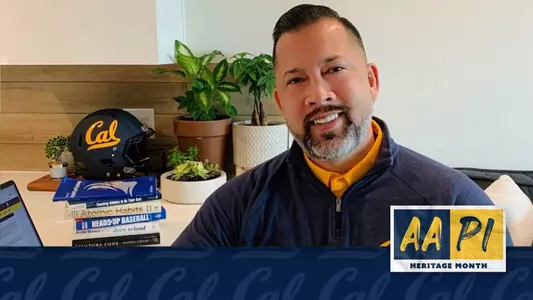
Photo by: Cal Athletics
Finding Belonging
5/6/2021 1:01 PM | Inside The Lair, Cameron Institute
Cameron Institute's Dr. Graig Chow Reflects On Biracial Identity
With the arrival of Asian American and Pacific Islander Heritage Month, Dr. Graig Chow recently reflected on his upbringing as a half-Chinese, half-white native of the Golden State.
The Director of High Performance & Well-Being for the Cameron Institute, Chow has spent the past year working with Cal's student-athletes, teams and coaches focusing on sports performance and sports psychology.
He returned to California to help build the Cameron Institute after working at Florida State and, prior to that, getting his PhD at Michigan State and psychology degree at UCLA.
Born in Garden Grove, some 34 miles southeast of Los Angeles, Chow was introduced to sports as a kid. Graig and his younger brothers, Brandon and Brian, played soccer and baseball. Chow played soccer and football at Pacifica High School and then stuck with soccer when he attended Golden West College in Huntington Beach.
Chow's father, Brad, who worked at the Los Angeles Department of Water and Power, is Chinese, and his mother, Lissa, who worked in an administrative role at a high school, is white. Brad Chow didn't learn to speak Chinese. He couldn't learn from his own parents, as his mother died when he was young and his father spent much of the time working. Likewise, his sons didn't learn Chinese.
In order to expose his sons to Chinese culture, Brad brought them to the Los Angeles Chinatown every week, and they would eat dim sum and watch the dragon and lion dance.
"That's one of my fondest memories, going to Chinatown," Chow said. "Because of that it affected me on a deeper level recently when some of those hate crimes happened in (Oakland's) Chinatown."
Chow had the common biracial experience of not feeling like he belonged to either side – neither with the Asian students nor with the white kids at his predominantly white high school.
"It's hard to see who's your tribe," he said. "I found that most of my friends growing up were biracial, just because we all experienced similar things growing up."
Interestingly, even with the last name of Chow, he finds that people don't always believe he's part Chinese.
"Even when I tell them I'm Chinese, they say, 'No, you're not. It's impossible,'" he said. "Some people think I'm every other thing but Chinese sometimes."
Chow has had a big impact in his first 12 months at Cal, in part thanks to his ethnic background.
One of the teams he's worked with is women's golf, which includes several Asian Americans as well as players from South Korea and Taiwan.
"There are some feelings of innate trust there because of that and because of his heritage," Cal head coach Nancy McDaniel said. "He has a good way of connecting. Our team trusts him and knows that they have someone to talk to about things that they might not be comfortable with. His voice is just strong, it's trustworthy and it's there for them. He's a rock for us."
McDaniel lauds Chow and the Cameron Institute, whose menu of services, including work with visualization and imagery, and hands-on approach were beneficial in the pandemic season of 2021.
"When they start quoting Graig – 'I talked to Graig, and so I think we should do this' – he's become like our 15th club in the bag," McDaniel said.
Chow also worked with the Cal field hockey program, starting in the fall, as the Bears hoped the pandemic wouldn't wipe out their season.
"He really got us going in the same direction, something a coach strives for every year," Cal head coach Shellie Onstead said. "We have a similar process every year where you try to get to common goals and direction, and it's nice to have a new voice to lead it. It took time and a lot of meetings to get everyone's voice heard, and this was during COVID, players adjusting to online learning, Black Lives Matter, so much going on all fall. And we lost a teammate, so it was really appropriate that I got some extra help."
When the field hockey team suffered the devastating loss of Zoë Rogers in October, Chow helped the Bears come up with ways to honor Rogers' memory all year long.
"To handle unprecedented times, you often have to learn new coping skills to navigate some of that uncertainty and stress," Chow said. "That's one part of my role that I've embraced in order to help student-athletes. You might be an athlete performing on your respective field, but how can these other things not have an effect on that, whether it be racial justice issues, the pandemic, academics or life issues? I don't treat from a mental health perspective, but those are always parts of the conversation as far as understanding each student-athlete's life."
The Director of High Performance & Well-Being for the Cameron Institute, Chow has spent the past year working with Cal's student-athletes, teams and coaches focusing on sports performance and sports psychology.
He returned to California to help build the Cameron Institute after working at Florida State and, prior to that, getting his PhD at Michigan State and psychology degree at UCLA.
Born in Garden Grove, some 34 miles southeast of Los Angeles, Chow was introduced to sports as a kid. Graig and his younger brothers, Brandon and Brian, played soccer and baseball. Chow played soccer and football at Pacifica High School and then stuck with soccer when he attended Golden West College in Huntington Beach.
Chow's father, Brad, who worked at the Los Angeles Department of Water and Power, is Chinese, and his mother, Lissa, who worked in an administrative role at a high school, is white. Brad Chow didn't learn to speak Chinese. He couldn't learn from his own parents, as his mother died when he was young and his father spent much of the time working. Likewise, his sons didn't learn Chinese.
In order to expose his sons to Chinese culture, Brad brought them to the Los Angeles Chinatown every week, and they would eat dim sum and watch the dragon and lion dance.
"That's one of my fondest memories, going to Chinatown," Chow said. "Because of that it affected me on a deeper level recently when some of those hate crimes happened in (Oakland's) Chinatown."
Chow had the common biracial experience of not feeling like he belonged to either side – neither with the Asian students nor with the white kids at his predominantly white high school.
"It's hard to see who's your tribe," he said. "I found that most of my friends growing up were biracial, just because we all experienced similar things growing up."
Interestingly, even with the last name of Chow, he finds that people don't always believe he's part Chinese.
"Even when I tell them I'm Chinese, they say, 'No, you're not. It's impossible,'" he said. "Some people think I'm every other thing but Chinese sometimes."
Chow has had a big impact in his first 12 months at Cal, in part thanks to his ethnic background.
One of the teams he's worked with is women's golf, which includes several Asian Americans as well as players from South Korea and Taiwan.
"There are some feelings of innate trust there because of that and because of his heritage," Cal head coach Nancy McDaniel said. "He has a good way of connecting. Our team trusts him and knows that they have someone to talk to about things that they might not be comfortable with. His voice is just strong, it's trustworthy and it's there for them. He's a rock for us."
McDaniel lauds Chow and the Cameron Institute, whose menu of services, including work with visualization and imagery, and hands-on approach were beneficial in the pandemic season of 2021.
"When they start quoting Graig – 'I talked to Graig, and so I think we should do this' – he's become like our 15th club in the bag," McDaniel said.
Chow also worked with the Cal field hockey program, starting in the fall, as the Bears hoped the pandemic wouldn't wipe out their season.
"He really got us going in the same direction, something a coach strives for every year," Cal head coach Shellie Onstead said. "We have a similar process every year where you try to get to common goals and direction, and it's nice to have a new voice to lead it. It took time and a lot of meetings to get everyone's voice heard, and this was during COVID, players adjusting to online learning, Black Lives Matter, so much going on all fall. And we lost a teammate, so it was really appropriate that I got some extra help."
When the field hockey team suffered the devastating loss of Zoë Rogers in October, Chow helped the Bears come up with ways to honor Rogers' memory all year long.
"To handle unprecedented times, you often have to learn new coping skills to navigate some of that uncertainty and stress," Chow said. "That's one part of my role that I've embraced in order to help student-athletes. You might be an athlete performing on your respective field, but how can these other things not have an effect on that, whether it be racial justice issues, the pandemic, academics or life issues? I don't treat from a mental health perspective, but those are always parts of the conversation as far as understanding each student-athlete's life."
Wednesday, February 10
Wednesday, February 10
Monday, August 31
Monday, August 31